James Brindley's Mill & Museum - Leek
James Brindley's Mill & Museum - Leek
Visit James Brindley’s Mill and Museum in Leek, a working 1752 water mill where visitors see the wheel, machinery, river history and local volunteers.
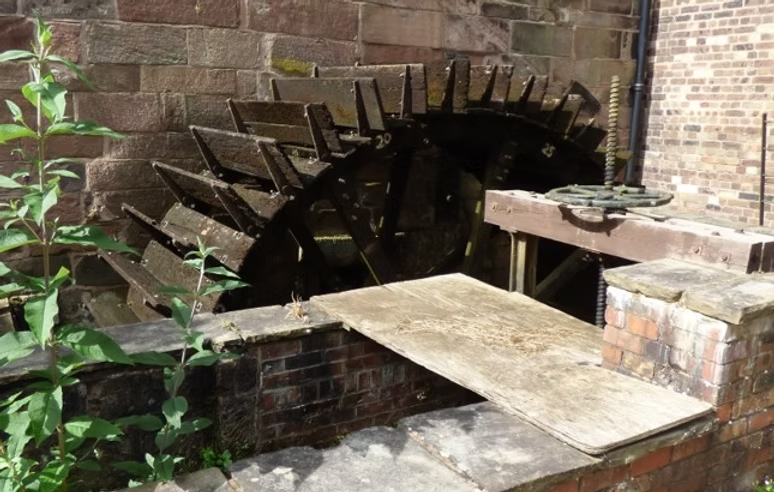
On a warm summer day in Leek, where the streets drop towards Mill Street and the River Churnet still moves through the town with the quiet authority of something older than the houses around it, James Brindley’s Mill and Museum stands as one of those small industrial survivals that asks for attention not by size but by persistence, for here the sound of water turning a wheel is not a recording, or a theatrical effect, but the old arrangement itself still doing its work, drawing power from a mill race that once belonged to a practical world of grain, labour, stone and timber. The mill dates from 1752 and is regarded as the only known corn mill built by James Brindley, the Staffordshire millwright who would later become one of the great canal engineers of the Industrial Revolution, and that knowledge gives the place a particular charge, because the visitor is not simply looking at machinery but at the mind of a working engineer before it widened into aqueducts, locks, tunnels and navigable water roads.
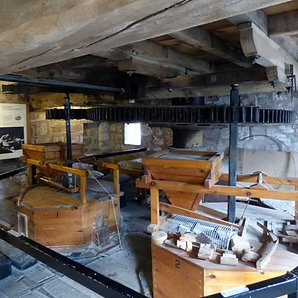
The first understanding of James Brindley’s Mill and Museum comes through its layout, where the mill race, sluices, wheel, gearing and stones reveal a chain of cause and consequence as clear as any sentence, with water taken from the Churnet, guided and narrowed by human hands, made to strike the wheel, then translated through timber shafts, pit wheels and millstones into the grinding of flour, so that the building becomes less an object than a sequence of decisions preserved in oak, iron and moving water. The mill continued in use until 1940, and more than a third of the building was lost in 1948 when the Macclesfield road was straightened, which gives the surviving structure a slightly severed dignity, as though part of its working body has gone but its pulse, astonishingly, remains.
Inside, where the volunteers explain the machinery with the calm enthusiasm of people who know that a place only survives when someone keeps returning to it with keys, oil, patience and memory, the turning wheel becomes a lesson in labour without ever becoming a lecture, because the visitor sees how flour was once made by the coordination of water, weather, grain, skill and local need, and how a small mill was part of a wider economy in which the town, the farms around it, the river below it and the roads that carried goods away were all bound together by movement. There is something deeply satisfying in watching machinery that still works because it was well conceived, and something quietly moving in the fact that James Brindley’s Mill and Museum is kept open by knowledgeable volunteers, whose presence forms a modern layer of labour over the older one, less muscular perhaps, but no less necessary.
Beyond the wheel and stones, the Churnet gives the place its longer memory, for rivers that served mills also received the consequences of industry, and Leek’s later textile and dyeing trades left their own marks on the water, although in recent decades the river corridor has also shown the quieter processes of recovery that follow when heavy industry retreats and bankside life begins to thicken again. Around such watercourses, ecology rarely returns as a grand gesture; it comes back in bankside vegetation, insects over slow water, birds using the corridor of the river, wet margins thickening after rain, and the patient reoccupation of places once disciplined by work, so that the mill race feels not merely historic but part of an altered river system still negotiating between engineering and life.
What remains most distinct about James Brindley’s Mill and Museum is the scale of it, for it does not overwhelm the visitor with spectacle but draws attention to the intelligence of ordinary mechanisms, to the way water was used before electricity hid power inside walls, and to the way an eighteenth-century working building can still hold summer light, volunteer voices, the smell of old timber, and the slow wheel turning through the same practical argument it has made for more than two and a half centuries. To leave the mill is to return to Leek with a slightly altered eye, noticing gradients, channels, roads and walls differently, because the town no longer appears merely as a pleasant Moorlands market town, but as a place shaped by water, industry, repair and continuity, where history has not vanished so much as become quieter, waiting beside the race for someone to listen.
Contact
214 Mill St,
Leek
ST13 8FA
- 01530 395530
- visit@brindleysmill.co.uk
- www.brindleysmill.co.uk
Reasons To Visit
James Brindley’s Mill and Museum in Leek preserves a working water-powered corn mill, where engineering, river movement and volunteer knowledge still shape the visit. It is a small but deeply layered industrial survival on Mill Street.
Close By - Worth Your Time
The Nicholson Museum & Art Gallery
Market Hall and Trestle Market
Best Local Cafe
Best Local Pub
Local Accommodation