Cromford Mills
Cromford Mills
The very beginnings of the industrial world still remain visible beside canal water, stone buildings and the wooded Derwent Valley.
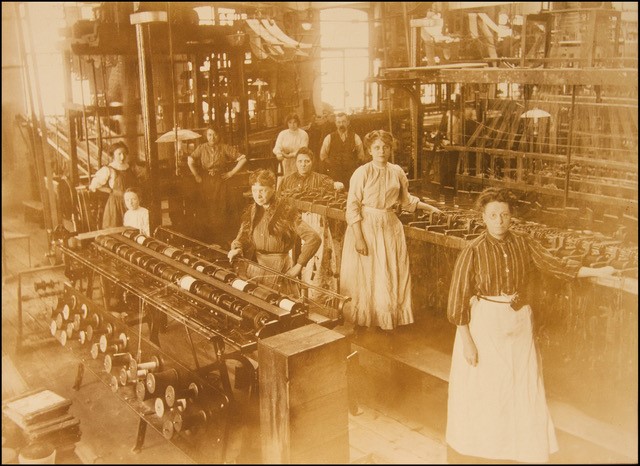
There are few places in Britain where the physical beginnings of the industrial world remain so visible, coherent and strangely intact as they do at Cromford Mills, and arriving beside the great stone mill buildings beneath the wooded slopes of the Derwent Valley one becomes aware almost immediately that this is not simply a preserved historical attraction but the surviving framework of a transformation that altered the rhythm of human life across much of the world, for it was here in the 1770s that Richard Arkwright developed a factory system whose logic of mechanised production, water power and organised labour would spread outward from these Derbyshire valleys into cities, ports and industrial regions far beyond England itself.
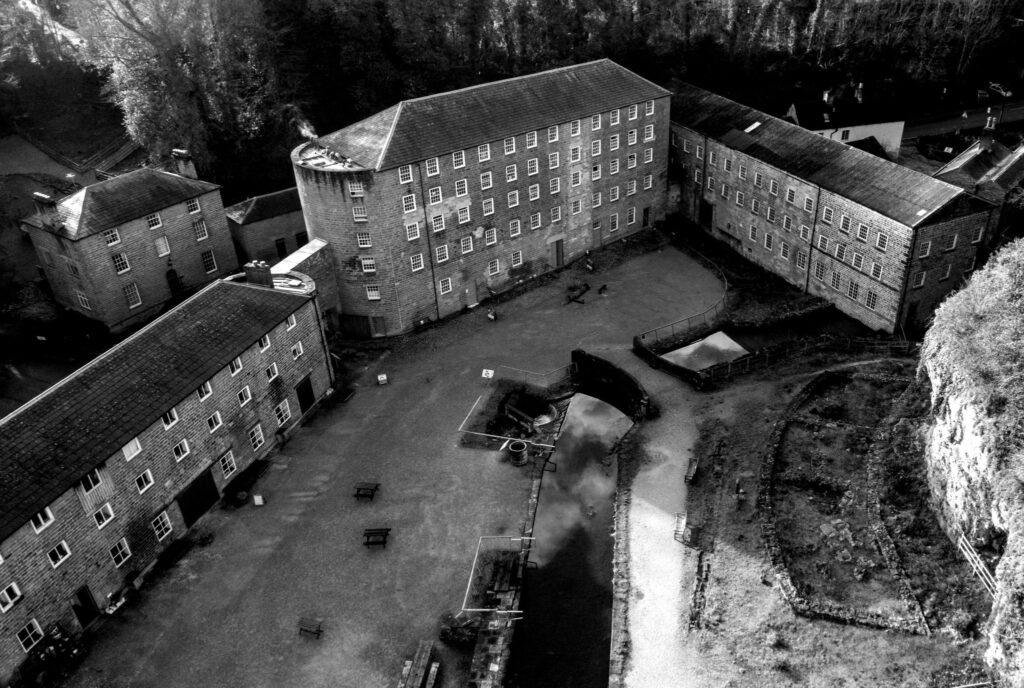
The setting appears at first unexpectedly rural for a place of such industrial significance, with the River Derwent moving quietly through trees below the hills and narrow lanes threading between cottages, inns and old workshops built from the local gritstone, yet the apparent calm conceals an extraordinarily deliberate engineering landscape in which water, gradient and transport were carefully organised to sustain continuous production, and walking through the mill yard toward the canals and sluices one notices repeatedly how the entire settlement was designed around movement and control: water directed through channels, workers housed within walking distance, goods transferred efficiently toward the canal network and later the railways, the valley itself reshaped into a functioning industrial organism whose influence extended deep into the developing modern economy.
What remains particularly striking while exploring the complex is the degree to which the original industrial logic survives physically within the architecture, since the long rows of windows, thick masonry walls and ordered internal spaces still reveal the requirements of early textile machinery driven continuously by water power drawn from the Bonsall Brook and Cromford Sough, itself an extraordinary drainage tunnel originally constructed for the lead mines higher in the hills, and here one begins to understand how the Industrial Revolution often emerged not through isolated invention but through the convergence of older systems of mining, hydrology, labour and transport whose interactions gradually produced entirely new forms of production.
Beyond the mill buildings the atmosphere softens along the towpaths of the Cromford Canal, where reeds, waterfowl and overhanging trees now occupy channels once crowded with barges carrying raw cotton, coal and finished goods through the Derwent Valley, and this gradual ecological reclamation produces the peculiar temporal layering characteristic of former industrial landscapes, for dragonflies move above water engineered originally for commerce while walkers and cyclists follow routes established to sustain manufacturing systems whose economic purpose has largely vanished, the landscape quietly absorbing industry back into woodland, moss and slow-moving water.
Inside the old mill complex itself there persists a faint sense of accumulated human repetition, as though the countless routines of spinning, maintenance, loading and supervision carried out over generations remain somehow embedded within the stone staircases and timber floors, and although cafés, exhibitions and small businesses now occupy parts of the site, the atmosphere never fully detaches from the labour history upon which the entire settlement depended, particularly during quieter afternoons when the sound of the river below the buildings begins merging with distant footsteps across the yard.
Toward evening, when shadow gathers gradually beneath the valley trees and the upper windows of the mill catch the last pale light above the canal basin, Cromford acquires the strange stillness common to places whose original purpose altered the world so completely that later generations scarcely notice its surviving foundations, and walking slowly back along the water one carries away the impression not merely of visiting an old factory, but of standing near the source of an industrial system whose consequences continue shaping modern life long after the machinery itself fell silent.
Contact
Mill Rd,
Cromford
DE4 3RQ
Reasons To Visit
The birthplace of Industrial Revolution – explore the world Richard Arkwright created – where canals, water power and industrial history still shape the valley landscape today.
Close By - Worth Your Time
Cromford Canal
Best Local Cafe
Best Local Pub
Local Accommodation
Weaver’s Cottage - Cromford
Middleton Top Campsite