Castleton and the Caverns Beneath
Castleton and the Caverns Beneath
Castleton’s caverns reveal a Derbyshire landscape shaped by limestone, lead mining, Blue John, underground waterways, village life and the weathered traces of labour.
Castleton sits beneath its hills with the particular force of a village that has never been separate from the stone around it, for the limestone does not merely form a backdrop here, but rises, folds, fractures and opens beneath the streets, carrying within it the old workings, natural chambers and mineral veins that have made this part of Derbyshire both a settlement and an underworld. Arriving in early summer, with sunlight moving quickly between scudding clouds and the green slopes lifted almost theatrically around the road, there is a strange first impression of entering a valley already half imagined, almost like Aldhani in Andor, not because the place feels artificial, but because the hills seem arranged with such improbable conviction that one has to remind oneself they were made by geology, water, pressure and time rather than by some production designer with a taste for grandeur.
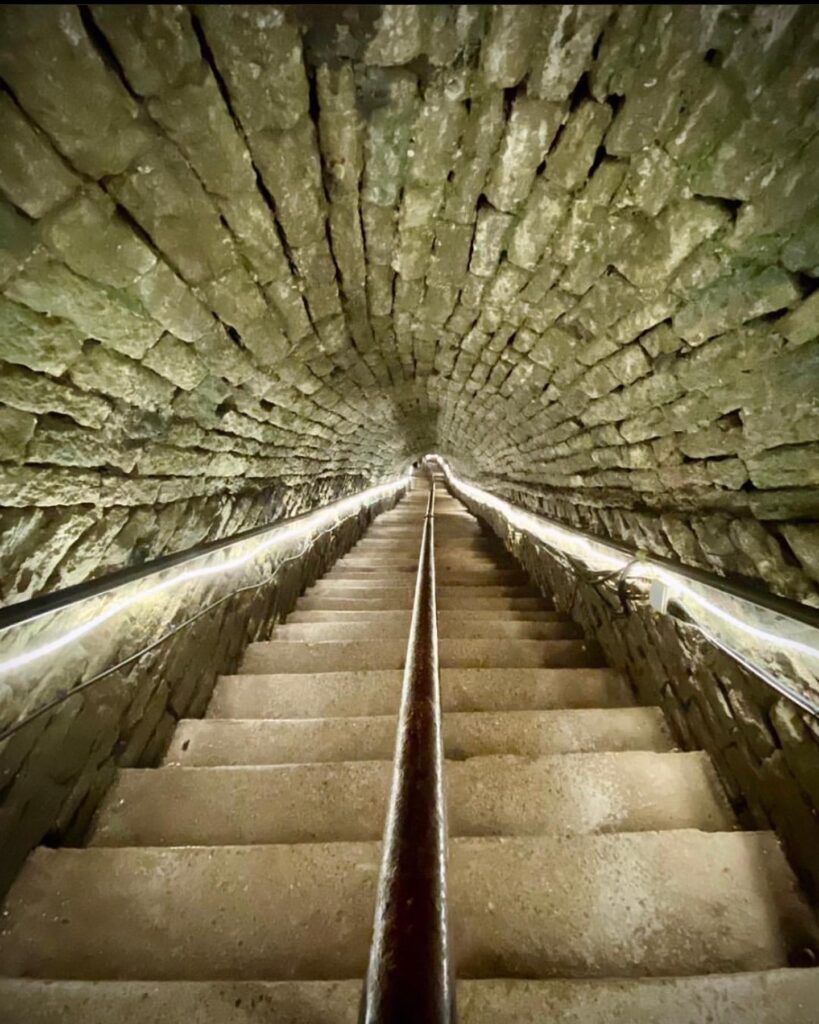
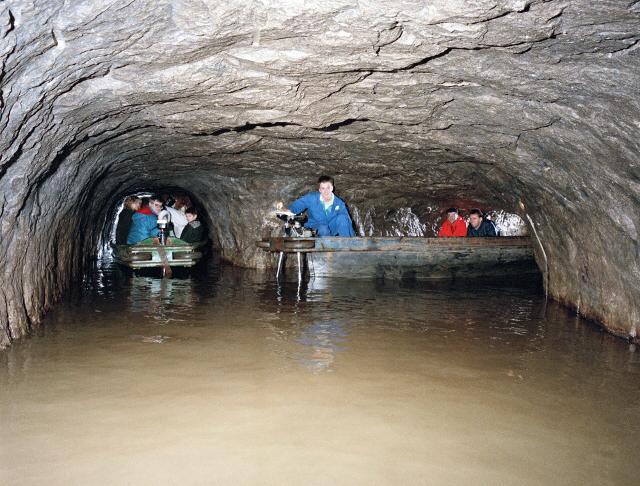
Speedwell Cavern, reached near the foot of Winnat’s Pass, carries this sense of landscape into the ground itself, though what is most striking is not only the darkness or the boat journey through the tunnel, but the knowledge that this peaceful passage began as an industrial gamble, when eighteenth-century investors drove a long canal through the rock in the hope of carrying lead ore out from beneath the hill. The enterprise failed as a mine, which is one of those useful historical ironies by which a practical ruin becomes a visitor’s memory, and today the boat moves through the level with a quietness that disguises the labour behind it, the cutting, hauling, water-management and candlelit persistence that once turned natural fissure into working passage.
Around Castleton, the caverns are not separate curiosities but parts of the same mineral story, with Blue John Cavern and Treak Cliff Cavern belonging to that rare banded fluorspar found only here, a stone whose purple, yellow and smoky veining turned geological accident into ornament, trade and local identity. Peak Cavern, with its vast entrance and older name, belongs more obviously to natural drama, though even there human use entered the mouth of the cave, where rope-makers once worked in the damp air because the conditions suited their craft, and where habitation, labour and folklore gathered under the same roof of limestone. Castleton therefore becomes a place where natural formation and human need are difficult to separate, because the caves were shaped first by water and rock, then altered by miners, tradesmen, guides, visitors and the small economic arrangements by which villages continue.
Above ground, the village holds the ordinary life that keeps such places from becoming museum pieces, with pubs, cafés, walkers, dogs, parked cars, waterproofs hung over chairs and people returning from Mam Tor with the wind still on them. This matters, because the caverns would feel diminished if they were only treated as spectacle; they belong instead to a working landscape that has changed its purpose, where lead, fluorspar, rope and transport have given way to walking boots, tea rooms and guided tours, without entirely erasing the older pattern beneath.
The weather helps to reveal this continuity, as sunlight shifts over the slopes and the greenery presses back into every ledge, verge and abandoned cut, softening the engineered scars without hiding them completely. In the valley, ecology is not decoration but recovery, with grass, fern, moss and scrub working patiently over the surfaces left by extraction and passage, while underground the water remains the older engineer, seeping, reflecting, carrying mineral traces and reminding the visitor that stone is never as still as it appears.
What remains after visiting Castleton is not simply the memory of caverns, though Speedwell Cavern in particular has the calm strangeness of a journey through a buried canal, but the sense of a village built at the meeting point of geology and necessity, where hills, minerals, labour and weather have all left their marks. The modern visitor comes for the caves, the Blue John, the walks and the pleasure of a Derbyshire village well supplied with places to sit and recover, yet leaves with something quieter too, an awareness that beneath the pleasant surface of Castleton there is another landscape still present, cut by hand, widened by ambition, darkened by failed enterprise, and carried forward now by guides, walkers, cafés and the steady human habit of finding new uses for old ground.
Contact
Hope Valley
S33 8WH
Reasons To Visit
Explore Castleton in Derbyshire through Speedwell Cavern, Blue John mines, limestone hills, village streets and the old workings that remain beneath them – with plenty of excellent cafes and pubs.
Close By - Worth Your Time
Mam Tor
Speedwell Cavern
Peveril Castle
Best Local Cafe
Castleton Kitchen
Three Roofs Cafe
Best Local Pub
The Castle
The George
Local Accommodation
Ye Olde Nags Head