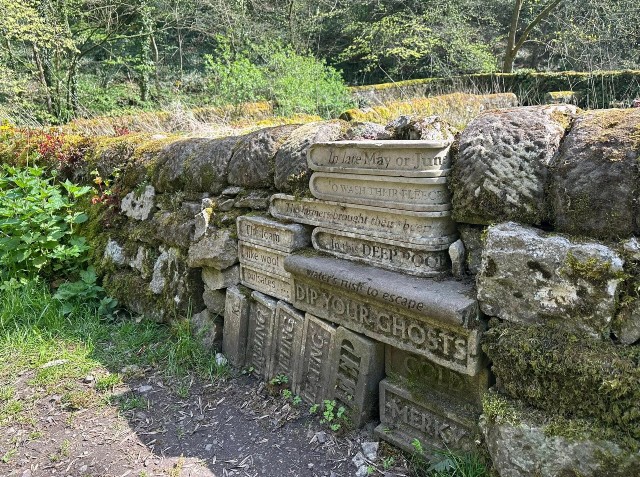
Bradford Dale - Youlgreave
Bradford Dale - Youlgreave
Bradford Dale below Youlgreave follows clear limestone water through weirs, sluices, trout ponds and riverside paths, linking village history with living ecology.
Bradford Dale comes quietly below Youlgreave, not as a grand limestone gorge but as a tucked-away working dale where water has been slowed, held, managed and released, and in early summer, under warm cloud, the River Bradford moves with the unhurried confidence of a stream that has been handled by human hands for a long time. The dale is shaped by limestone, clear spring-fed water and a sequence of weirs, sluices and pools, so that what first appears natural soon reveals itself as a managed waterscape, part river, part fishery, part village resource, and part green corridor between Youlgreave, Alport and the meeting with Lathkill Dale.
The path along Bradford Dale gives a good physical lesson in how water creates use: the river widens behind small dams, narrows again through channels, slips over weirs, gathers in quiet ponds, then moves on beneath footbridges and beside grassed banks where walkers pause, dogs nose at the edges and the sound of water repeats itself in different registers. Some of these pools were associated with trout management and fishing, while upstream at Gooseholme the remains of water management connected with former mills and village water supply still belong to the broader story of the dale, where the river was never merely decorative but was made to work.
The old trout rearing ponds are perhaps the most telling detail, because they show Bradford Dale in that half-domesticated state between wild stream and practical rural system, where fish, water levels, sluice boards and estate management all became part of the valley’s rhythm. Brown trout remain part of the river’s life, and the Bradford is also known for clear limestone water, dippers, kingfishers and white-clawed crayfish, though the very structures that created the quiet pools also altered the river’s natural movement, slowing gravel, changing flow and complicating the passage of fish.
That tension gives Bradford Dale much of its interest today, for ecology here is not simply a matter of pretty banks and summer growth, but of recovery, adjustment and argument between inherited engineering and living water. Where sluices have been opened and levels lowered, the river can begin to cut a more natural course through former pond beds, allowing vegetation to settle, insects to return, and floodplain behaviour to reappear in miniature; where deeper impounded water remains, it still gives shelter and visual beauty, but also reminds the visitor that every managed landscape carries consequences downstream.
As a walk, Bradford Dale is at its best when taken slowly, especially as part of the Youlgreave loop with Lathkill Dale, where the Bradford’s intimate, held water contrasts with the wider drama and ecological richness of the Lathkill. Parking around Youlgreave can be limited, so this is a place to arrive with patience rather than hurry, and perhaps to think of the day in older terms: path, river, bridge, village, food afterwards, boots drying by the car, the small reward of having followed water through a dale that still remembers its uses.
Bradford Dale lingers because it does not separate beauty from function. Its sluices, ponds, trout water, footpaths and summer weed all belong to the same quiet record, in which human need, limestone flow and ecological patience continue their long conversation beneath Youlgreave.
Contact
Bradford,
Youlgreave
DE45 1WG
Reasons To Visit
Bradford Dale below Youlgreave is a quiet limestone river landscape shaped by sluices, trout ponds, village water use and ecological recovery. It also forms a rewarding walking loop with Lathkill Dale.
Close By - Worth Your Time
Nine Stones Close Stone Circle
Robin Hood's Stride
Alport
Best Local Cafe
Fountain View Bakery
Best Local Pub
George Hotel, Youlgreave
Local Accommodation