Cheddleton Flint Mill
Cheddleton Flint Mill
Cheddleton Flint Mill preserves Staffordshire's industrial story through working water wheels, welcoming volunteers, peaceful canalside walks and living connections between river, railway and pottery.
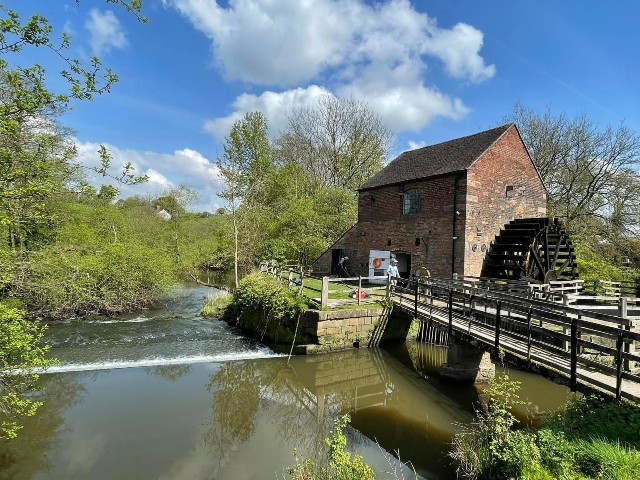
There is something quietly reassuring about arriving at Cheddleton Flint Mill on a warm summer afternoon. The River Churnet slips past with the same patient purpose that first drew millers here centuries ago, while the steady rhythm of water turning timber and iron reminds visitors that this is not simply a museum preserving machinery behind barriers, but a place where engineering still performs the work it was designed to do. Good parking makes arrival straightforward, and the short walk from the nearby Churnet Valley Railway follows the canal through one of Staffordshire’s most complete industrial landscapes, where river, railway and waterway remain threaded together much as they once were.
The mill itself sits within a landscape that seems almost inevitable once its geography is understood. The Churnet provided reliable water power, the Caldon Canal offered a dependable route for heavy cargoes, and later the railway strengthened connections with the Potteries only a few miles away. Looking across towards the stone buildings, it becomes clear that this was never an isolated rural enterprise. It formed part of an industrial system whose influence extended across North Staffordshire, linking remote valleys with workshops, kilns and markets far beyond the county.
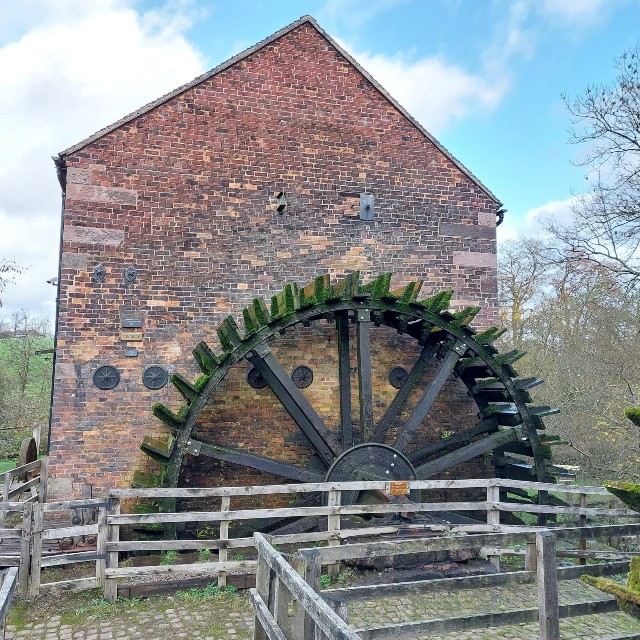
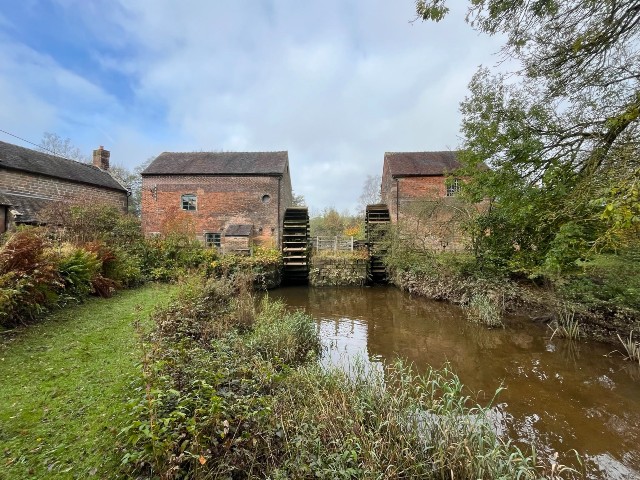
Its story begins not with pottery but with grain. Like many English watermills, Cheddleton originally served surrounding farms by grinding corn, responding to the everyday needs of local communities. During the eighteenth century, however, the remarkable growth of the Staffordshire pottery industry transformed the economics of the valley. Potters required finely ground flint to produce the white bodies that helped make their wares famous across Britain and overseas. Flint arrived by sea from the south coast and East Anglia before travelling inland by canal, eventually reaching Cheddleton where the river’s energy powered great edge-runner stones beneath two impressive water wheels. Here the hard nodules were crushed into an exceptionally fine powder before continuing their journey to the factories of Stoke-on-Trent. It is a reminder that celebrated industries often depended upon quieter places whose names rarely appeared on finished products.
Today, that industrial process survives not as static interpretation but as living demonstration. The two great water wheels still turn with satisfying authority, translating flowing water into motion through shafts, gears and belts that remain both elegant and surprisingly comprehensible. Friendly volunteers bridge the centuries with infectious enthusiasm, explaining not simply how the machinery works but why it mattered. Even a visit shortly before closing can become unexpectedly memorable when those entrusted with the building’s care bring its story to life with genuine knowledge and obvious affection. The experience feels less like attending a museum and more like being welcomed into a working workshop whose craftsmen have briefly stepped outside.
Outside the buildings, nature has quietly softened the harder edges of industry. The River Churnet now supports kingfishers, dippers and grey wagtails that depend upon its clean, fast-flowing water, while dragonflies patrol the calmer stretches beside the canal during summer. Mosses spread across old stonework, lichens settle on weathered walls, and mature trees shade sections of the towpath where freight boats once carried cargoes of limestone, coal and flint. The canal, originally built as industrial infrastructure, has become an ecological corridor connecting woodland, meadow and wetland habitats, allowing wildlife to move through the valley almost unnoticed by those simply passing through.
A short canalside walk leads naturally towards the Churnet Valley Railway, where another chapter of industrial transport continues to operate beneath clouds of steam rather than diesel exhaust. Together, the railway and the mill reveal how power once flowed through this valley in many forms: water turning wheels, steam driving locomotives, horses hauling narrowboats and generations of skilled hands converting raw materials into finished goods. Between them sits a welcoming café serving tea, coffee and homemade cakes, offering precisely the sort of uncomplicated hospitality that suits a place built upon honest work rather than spectacle.
Cheddleton Flint Mill asks very little of its visitors beyond curiosity. Entry is free, although donations help sustain both the machinery and the volunteers who continue its story. In an age when so much industrial heritage survives only as photographs or foundations, there is quiet satisfaction in standing beside a wheel that still turns exactly as it did generations ago. The water continues downstream, the machinery continues its measured movement, and the valley reminds us that landscapes are often best understood not through their monuments alone, but through the working relationships between river, stone, transport and people that have endured across centuries.
Contact
Cheddleton,
ST13 7HL
- 01614 085083
- info@cheddletonflintmill.com
- cheddletonflintmill.com
Reasons To Visit
Cheddleton Flint Mill is a living museum where working water wheels, pottery history, canals and railway heritage combine within one of Staffordshire’s finest industrial landscapes.
Close By - Worth Your Time
Best Local Cafe
Nice Tea Room on Site
Cheddleton Old School Tea Rooms
Best Local Pub
The Black Lion - Cheddleton
Local Accommodation