Tissington
Tissington
Tissington holds hall, wells, trail and village businesses together, a White Peak estate village where water, limestone and family memory remain visible under summer sun.
Tissington is approached with the peculiar pleasure of arriving somewhere that has not quite surrendered its old arrangement to the modern road, for the village lies just off the Ashbourne to Buxton line of traffic, yet once inside it the pace alters, the stone houses, hall, church, pond, wells and small businesses holding the place together with the quiet discipline of an estate village that still knows its own shape. In early summer, with warm sun lying across the limestone walls and the lanes brightened by the easy movement of visitors, cyclists and walkers, it has the quality of a time capsule without feeling sealed off, because the life of the place continues in cups of tea, shop doors, parked bicycles, dogs waiting under tables and people reading the village slowly rather than rushing through it.
The centre of Tissington is governed physically and historically by Tissington Hall, built in 1609 by Francis FitzHerbert, with St Mary’s Church raised nearby and the village arranged along a street whose open spaces, pond and approach roads make the settlement feel planned rather than accidental. This is not industrial country in the blackened, furnace-lit sense, but it belongs to another kind of working landscape, one of estate management, farming, water supply, stone building, road movement and the patient labour of maintaining walls, wells, fields and houses over generations. Even the neatness has work behind it, for places like this do not preserve themselves by charm alone.
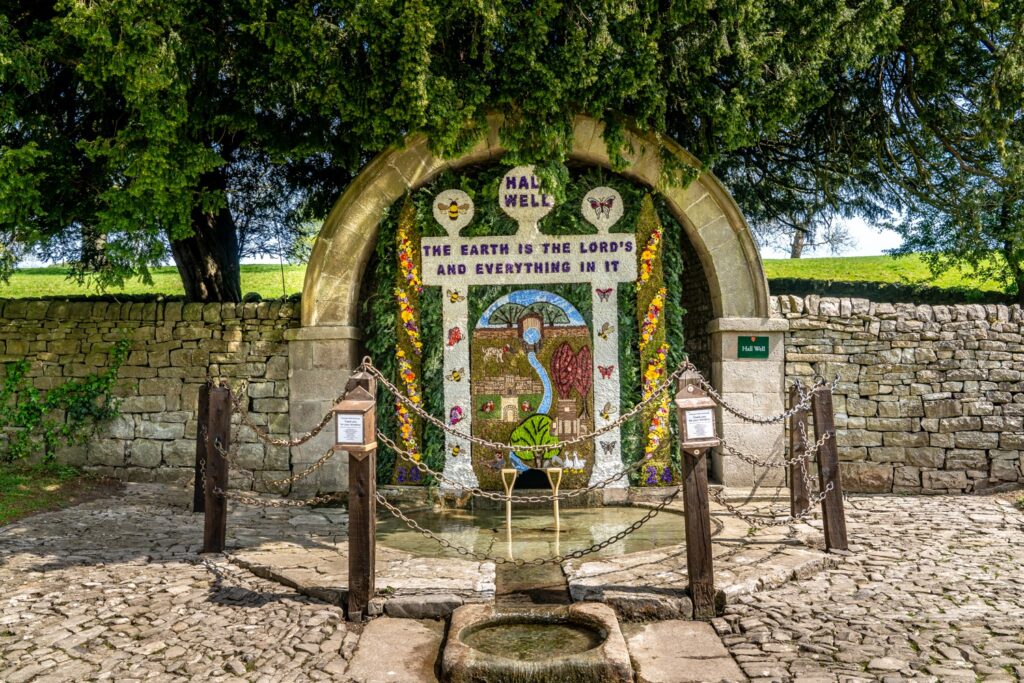
The well dressing tradition gives Tissington its deepest visible ceremony, because water here is not just a picturesque detail but a reason for gathering, thanksgiving and continuity. During the 1940s the custom stopped, as war drew helpers away into service, but in 1949 Chris Carr and Ken Unwin revived Hands Well with jars of wild flowers, and the following year the tradition resumed more fully, passing back into the hands of families, committees, designers, clay diggers and younger helpers. That detail matters, because it shows how heritage survives not as a label on a board, but through repeated labour, remembered methods and descendants still willing to kneel over clay and petals so that water, family and village identity remain bound together.
Beyond the houses, the Tissington Trail adds another layer of movement, following the former railway between Ashbourne and Buxton, now reused by walkers, cyclists and horse riders rather than trains, milk traffic or railway workers. It is a fine example of how an engineered line can lose one purpose and gain another, its cuttings, gradients and old railway logic becoming a leisure route through the White Peak, where limestone country drains, flowers, weathers and exposes itself in walls, pasture, dry dales, springs and the occasional sharp gleam of pale stone.
The village businesses deserve proper attention rather than a hurried glance, because they are part of the way Tissington works today: cafés, gift shops, craft spaces and small local enterprises give visitors reasons to linger, and they prevent the village from becoming merely a preserved exhibit. Sit down for coffee or something simple to eat, look back at the street, and the place begins to explain itself: hall, church, wells, trail, shopfronts, car park and field paths all joined by use, with the past not behind glass, but underfoot.
Contact
Tissington,
DE6 1RA
Reasons To Visit
Tissington is a White Peak estate village where wells, hall, church, trail and small businesses still hold the shape of older rural life. In early summer it feels both preserved and active, with water, limestone, family memory and visitor movement all visible in the same calm street.
Close By - Worth Your Time
Tissington Trail
Carsington Water
Best Local Cafe
Herbert's Fine English Tea Rooms
Best Local Pub
Local Accommodation
Tissington Caravan/Motorhome Site
Tissington Ford Barn