The Roaches - Myths & Legends
The Roaches - Myths & Legends
The Roaches offer sharp gritstone views, old tracks, folklore, climbing ground and moorland ecology shaped by weather, labour, legend and repeated human passage.
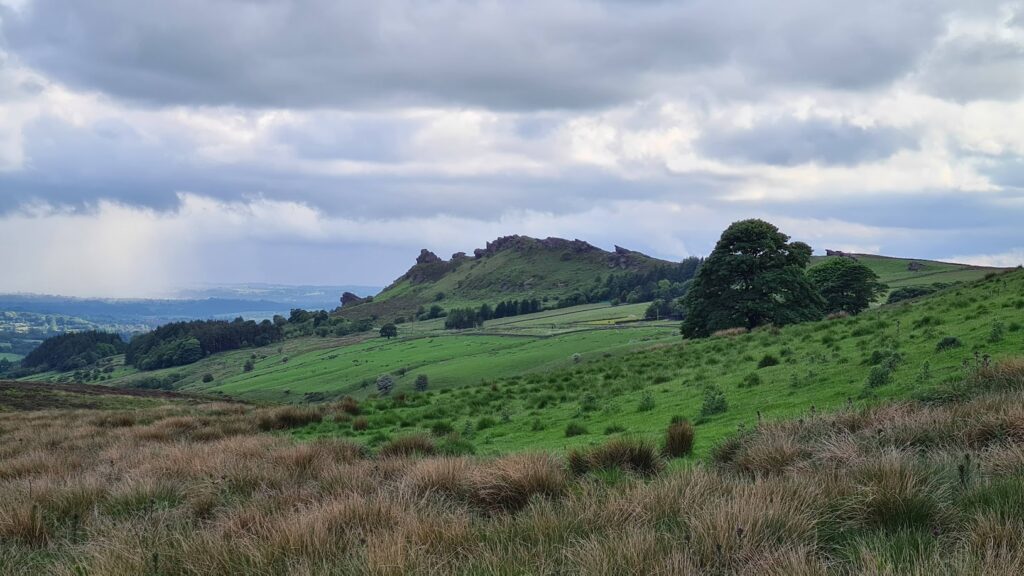
The Roaches rise above the Staffordshire Moorlands with the hard, jagged certainty of a place that has been shaped less by ornament than by weather, stone, footfall and long human use, their dark gritstone edge standing over the country north of Leek like the broken rim of some older world, where sheep tracks, climbing routes, farm lanes and walking paths now cross ground that has always required effort from those who came here, whether they came for grazing, stone, shelter, work, escape, or the clear high view that still draws people upward in hot weather when the moor smells of grass, bracken and sun-warmed rock.
The first understanding of The Roaches comes through their outline, because the ridge is not a soft hill but a long exposed formation of gritstone, lifted, weathered and left in blocks and edges that explain at once why the place became useful, difficult and memorable, with walls, tracks and paths all responding to the same physical facts of slope, stone and exposure, while the open views across the Moorlands show how settlements, farms and roads have gathered below in the lower, more practical ground where water, shelter and transport made daily life possible.
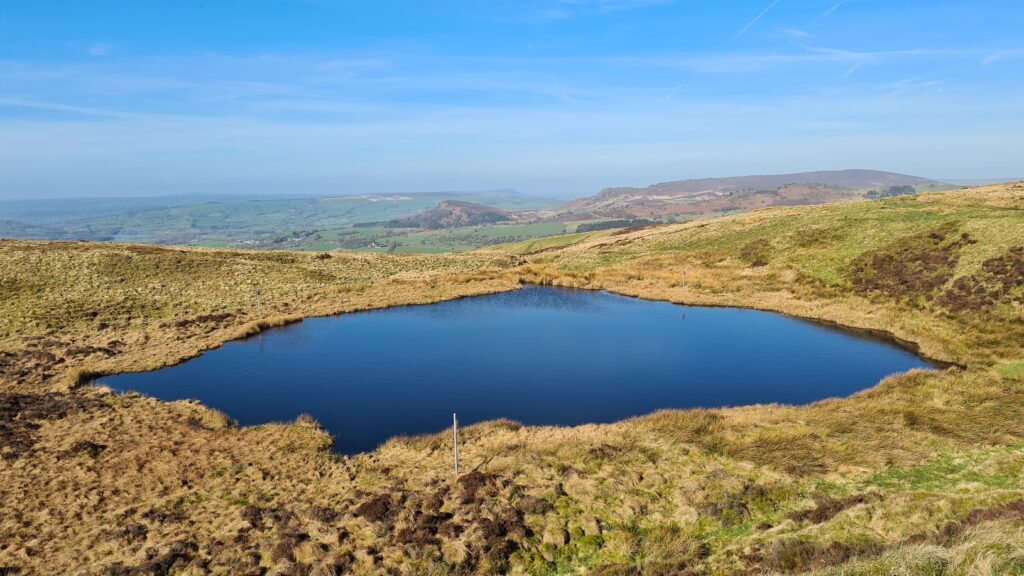
Along the ridge, Doxey Pool sits with a stillness that feels older than the footpath around it, and though it is a small upland pool rather than the bottomless place of legend, its dark surface has gathered around itself the story of Jenny Greenteeth, the water spirit said to lure the unwary down into the depths, which is perhaps less a simple ghost tale than a warning carried through generations about bog, water, mist, loose footing and the danger of treating wild ground too casually.
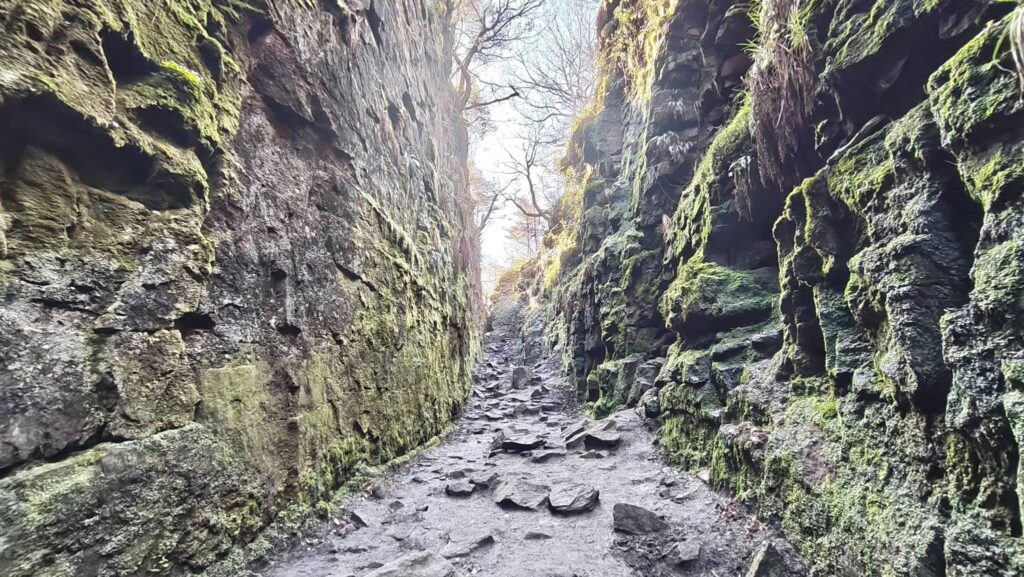
The folklore of The Roaches belongs naturally to the physical place, because the same broken rocks and sudden hollows that make good climbing country also make good story country, and the wider landscape pulls in Lud’s Church, associated with Sir Gawain and the Green Knight, the Singing Woman near Rock Hall, the Bawdstone with its old healing reputation, and the Winking Man at Ramshaw Rocks, where a trick of movement and angle turns stone into a brief human gesture for anyone passing below on the road.
In early summer, with heat lying on the ridge and the outcrop sharpened into silhouette, the place feels busy without being spoiled, as walkers move along the higher paths, climbers test themselves against the gritstone faces, dogs nose through the heather edges, and families pause near the views, all of them entering a landscape already marked by repeated passage, where the paths are not decorative additions but worn lines made by habit, necessity and recreation over many years.
The Roaches are not industrial in the heavy mill-and-furnace sense, yet their memory is still one of labour and practical use, visible in drystone walls, old tracks, farm boundaries, managed access routes, quarry-like scars, and the way the land has been divided, crossed and worked, while the larger industrial districts of the Moorlands and nearby towns remain just beyond the view, connected by the same geology that provided hard stone, rough grazing, transport difficulties and a landscape that shaped human choices long before visitors arrived with boots and cameras.
Ecology has made its own return across this hard country, and the ridge now carries heather, bilberry, grasses, bracken, nesting birds and the famous peregrines that have at times required climbing restrictions, a practical reminder that recreation must share the rock with other claims, while the strange story of Bennett’s wallabies, descended from animals released from a private collection, adds one more unlikely layer to a place already crowded with legend, local memory and natural adaptation.
What remains most distinct about The Roaches is not any single story but the way stone, weather, folklore and use hold together without needing much explanation, for the ridge gives its history through surfaces rather than signs, through the worn steps of walkers, the grip marks of climbers, the shadow around Doxey Pool, the wall lines running across the slopes, and the scattered parking places below where modern visitors begin the same old negotiation with height, distance and rough ground.
By the time the path drops back from the edge, The Roaches have become less a viewpoint than a record of pressure and survival, where geology has given shape, weather has worked slowly, human movement has made its lines, birds have claimed the faces, stories have settled into the pools and rocks, and the modern walker leaves with the sense that this sharp dark ridge above Leek is still being read, crossed and remembered rather than simply visited.
Contact
Leek
ST13 8UQ
Reasons To Visit
The Roaches rise above the Staffordshire Moorlands as a gritstone ridge shaped by geology, weather, folklore and repeated human use. Walkers, climbers and wildlife now occupy a landscape where older traces remain visible in stone, paths and story.
Close By - Worth Your Time
Tittesworth Water
Best Local Cafe
Flash Bar Stores
Best Local Pub
The Winking Man
Local Accommodation
Hazel Barrow Farm Camping
Lapwing Hall Farm Camp Site