The Manifold Valley
The Manifold Valley
The Manifold Valley is a layered Staffordshire landscape where limestone, vanished water, railway memory and ancient human occupation still shape the experience of walking through the dale.
The Manifold Valley is one of those Staffordshire places where the land seems to fold in on itself, not in secrecy, but through the ordinary work of limestone, water and time, so that a short journey from Longnor can carry you from soft pasture into sudden ravine, from open meadow into the shadow of a cave mouth, and from present-day walking country into a valley whose shape has been decided by rivers, railways, animals, miners, farmers, visitors, and the long practical intelligence of people moving through difficult ground.
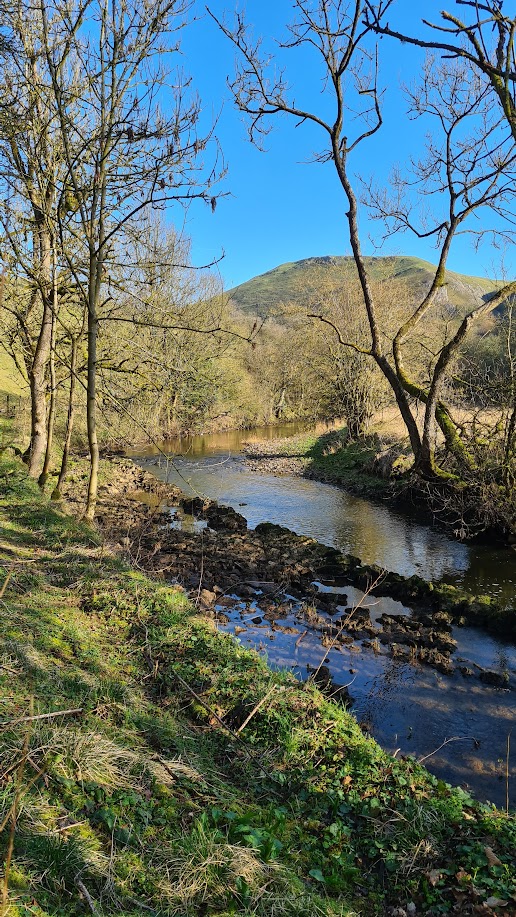
The name itself carries the logic of the place, for the many serpentine bends and meanders of the River Manifold give the valley its character, although in dry weather the river performs one of its stranger disappearances, slipping underground through swallets south of Wetton Mill and re-emerging later in the grounds of Ilam Hall, leaving the valley floor with the curious feeling of a river corridor temporarily abandoned by its river.
Above this intermittent watercourse, the arch of Thor’s Cave stands in the limestone like an opening cut by older hands than ours, and although it is now reached by walkers, families, dogs, cyclists and the occasional breathless pilgrim from the car park, evidence from the cave reaches back around 10,000 to 11,000 years, with stone tools, pottery, amber beads, bronze items and burial remains showing that this was never merely scenery, but a place of shelter, ritual, use and return.
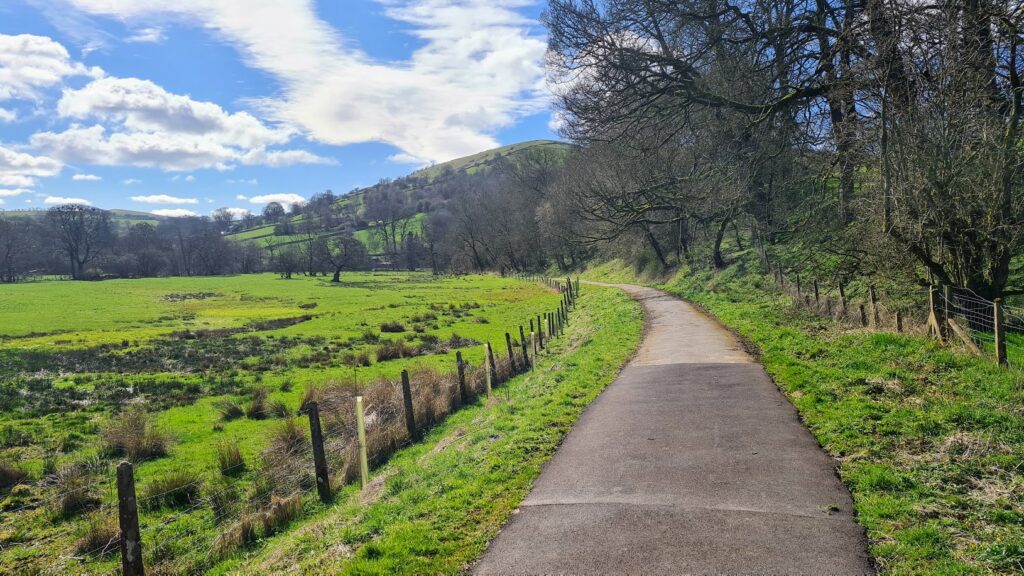
Along the valley floor, the modern Manifold Way follows the former route of the Leek and Manifold Valley Light Railway, a narrow-gauge line that ran from 1904 to 1934, carrying milk from local dairies as well as passengers moving between villages, farms and beauty spots, its engineering shaped by economy and necessity, its rails laid where the valley allowed movement and its small stations answering to a countryside whose settlements often sat inconveniently above the line.
There is something faintly dreamlike now in imagining the primrose-yellow locomotives, modelled on engines associated with India, passing through this damp English limestone country with churns, parcels, visitors and local business in tow, yet the railway was not whimsical in its purpose, for it existed because milk, cheese, people and goods needed a route through a valley where roads were limited and gradients mattered.
What remains is not a ruin in the grand sense, but something more usable and therefore more revealing: a surfaced track, old alignments, bridge logic, tunnel memory, former loading places, and the steady human pattern of walkers and cyclists occupying the bed of a railway whose decline came when dairy traffic shifted to road and other transport served the hill villages more directly.
The ecology of The Manifold Valley has its own form of recovery, for the same limestone that drains the river also shapes the grassland, cliffs, damp hollows and shaded banks, allowing the valley to move quickly between open grazing, enclosed woodland, ferned ravine and bare rock, while the old transport corridor gives plants, insects, birds and people a shared passage through ground once disciplined by rail, ballast, sleepers and timetable.
Human continuity remains strong here, not through preservation alone but through use, with Wetton Mill, Hulme End, nearby pubs, cafés, walkers’ cars, dogs at gates, cyclists on the old track and Longnor serving as a practical hub for anyone wanting to approach the valley without rushing it, for this is a landscape better understood by several slow returns than by one impatient circuit.
The deeper character of The Manifold Valley lies in this layering of systems, where geology made the gorge, water found and lost its course, early people used the cave, farmers worked the slopes, dairies needed transport, engineers threaded a railway through the valley floor, and modern visitors now move through the remains of those arrangements without always seeing how much older labour lies beneath their ease.
To leave The Manifold Valley in early summer heat is not to feel that anything has been solved, but rather that the place has quietly disclosed its method: stone holding memory, water vanishing and returning, grass softening old industrial purpose, and the path ahead carrying, beneath each ordinary footstep, the faint pressure of all those who had reason to pass this way before.
Contact
Longnor/Hulme End/Wetton Mill
ST13 7TP
Reasons To Visit
Visit The Manifold Valley for limestone drama, vanished river sections, Thor’s Cave, railway history, quiet walks, village cafés, and deep Staffordshire landscape memory.
Close By - Worth Your Time
Best Local Cafe
Best Local Pub
Local Accommodation