Chrome Hill & Parkhouse Hill
Chrome Hill & Parkhouse Hill
Chrome Hill and Parkhouse Hill rise from ancient reef limestone, where sheep tracks, walkers and weather still shape the upper Dove Valley.
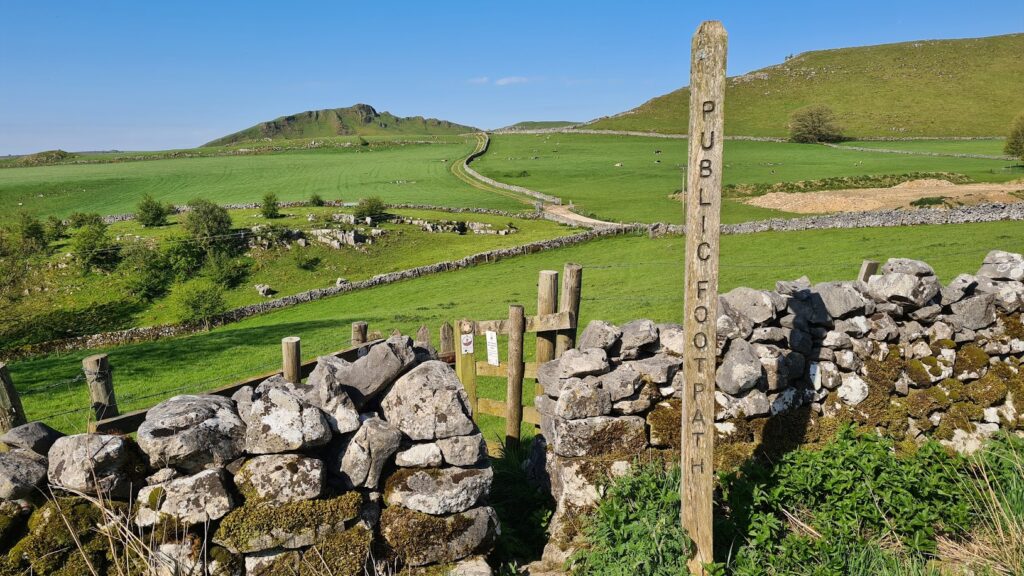
Chrome Hill and Parkhouse Hill stand above the upper Dove Valley with a strangeness that is immediately apparent, for this is not the softened limestone country of easy dales and folded pasture, but a sharper survival from a much older world, where reef knolls formed in a warm Carboniferous sea have been left standing after ice, water and weather carried away the weaker ground around them. From Hollinsclough, where parking is slight and the lanes still belong first to farms, walls and patient local traffic, the hills rise with the look of something exposed rather than displayed, their ridges pulling the eye across the valley towards Longnor and down to the River Dove far below.
Across the slopes of Chrome Hill and Parkhouse Hill, the layout of the place begins to explain itself without boards or speeches, because the narrow backs, steep flanks, limestone outcrops and grassed scars show how geology has governed every later human decision, from the siting of tracks and field walls to the way sheep move along shelves of safer ground. The name Dragon’s Back is understandable, though it is the older marine origin that gives the hills their real authority, for these apparent little mountains are built from the remains of ancient sea life, with fossil-bearing limestone still visible in places, though the ground is protected and should be left untouched.
In early summer the scene has a brightness that does not soften the structure, for the sun only makes the limestone edges more legible, while short turf, thyme, orchids, scrub, exposed rock and the rare Jacob’s Ladder plant show how thin calcareous soils support a specialised ecology that survives because the land has never been made ordinary. The River Dove, moving far below with the quiet persistence of water doing ancient work, belongs to the same system, cutting, draining and reflecting the valley while the hills remain above it like remnants of a vanished sea floor raised into pasture.
Human continuity here is quieter than at a mill, a quarry or a canal basin, but it is still present in every trodden path, every sheep line, every patched wall and every walker pausing on the ridge to understand why this place feels different from the gentler country around it. The modern visitor brings boots, dogs, cameras and sandwiches rather than tools, and yet the route remains a working landscape rather than a scenic exhibit, with Hollinsclough, Longnor and the surrounding farms holding the place in the practical rhythm of upland life.
The final image of Peaky Blinders gave Chrome Hill and Parkhouse Hill a newer cultural afterlife, placing this old geological drama inside a modern myth of departure and survival, though the hills did not need television to make them memorable. Their deeper power lies in the way they gather time without announcing it: tropical sea, glacial erosion, grazing, field enclosure, footpath, sheep track, television frame, summer grass.
What remains after walking Chrome Hill and Parkhouse Hill is not simply the memory of a view, but the feeling of having crossed a landscape where the ordinary surface of England has torn slightly open, allowing limestone, weather, ecology and human use to show through in one continuous, weathered seam.
Contact
Hollingsclough
Buxton
SK17 0RH
Reasons To Visit
Explore the iconic Chrome Hill and Parkhouse Hills near Longnor, where reef limestone, rare plants, old paths and Dove Valley views shape a memorable walk.
Close By - Worth Your Time
Explore ancient Hollingsclough
Best Local Cafe
Best Local Pub
Cheshire Cheese - Longnor
Local Accommodation
Moorside Farm Bunkhouse